
AI Writing and Plagiarism: What You Need to Know
July 22, 2025

AI writing tools are changing content creation. They can generate text quickly, blurring lines of originality and authorship. Distinguishing human from AI content is increasingly difficult. This prompts a re-evaluation of academic integrity and ethical boundaries. Institutions must establish guidelines for responsible AI use. Protecting content requires transparency and verification methods. Continued exploration reveals further insights into maneuvering these evolving practices.
Key Takeaways
- AI tools generate content rapidly, blurring lines of authenticity.
- Originality and authorship are being redefined by AI capabilities.
- Detecting AI-generated content is challenging but possible.
- Academic integrity requires clear guidelines on AI use.
- Transparency and human oversight protect content originality.
The Rise of AI-Generated Content
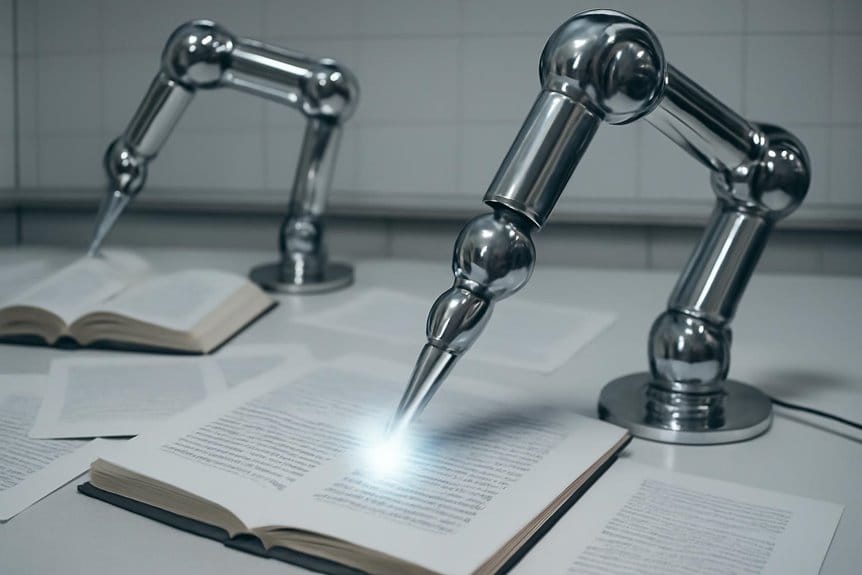
How has the proliferation of artificial intelligence tools impacted the creation and dissemination of written material? The advent of sophisticated AI writing assistants has fundamentally reshaped the landscape of content production. These tools can generate text at an unprecedented scale and speed, influencing everything from marketing copy to academic essays.
This rapid evolution raises significant questions regarding AI ethics. The ease with which AI can produce plausible-sounding text also presents challenges to maintaining content authenticity. Distinguishing between human-authored and AI-generated material is becoming increasingly difficult, necessitating new approaches to verification and attribution within the writing ecosystem.
The implications for intellectual property and the value placed on human creativity are considerable. As AI writing tools become more advanced, they offer versatile content creation options that cater to various needs, from creative writing to professional tasks.
Redefining Originality in the Age of AI
The pervasive influence of artificial intelligence introduces a profound challenge to traditional notions of original thought and expression. As AI tools become more sophisticated in generating text, the very definition of authorship and originality requires re-evaluation. What was once a clear distinction between human creation and unoriginal work now blurs. This evolution necessitates a nuanced approach to understanding copyright, attribution, and the fundamental principles of creative integrity. Establishing clear authorship ethics is paramount in steering this landscape, ensuring that the contribution of both human intellect and AI assistance is appropriately acknowledged and valued. The focus shifts from solely the act of creation to the intent, curation, and refinement process undertaken by the individual. As AI continues to advance, balancing AI assistance with authorial control becomes crucial in maintaining the quality and originality of creative works.
Identifying AI-Assisted and AI-Generated Text
When attempting to distinguish between human-authored, AI-assisted, and purely AI-generated content, a complex diagnostic challenge emerges. While sophisticated AI detection tools are continually being developed, they are not foolproof. These tools often analyze linguistic patterns, sentence structure, and vocabulary choices that may deviate from typical human writing styles. However, as AI models improve, their output becomes increasingly nuanced and harder to discern. The effectiveness of AI detection is also limited by the fact that AI can be used to *assist* human writers, subtly improving their work without rendering it entirely machine-generated. Consequently, robust plagiarism prevention strategies often require a multi-faceted approach that goes beyond purely technical AI detection, incorporating critical human review. Over-reliance on any single method for identifying AI-generated text risks both false positives and false negatives. Moreover, Grammarly's AI Writer offers advanced features that can aid in creating high-quality, original content while providing tools to enhance writing accuracy and productivity.
Ethical Considerations for AI in Academia and Work
Why do the increasing capabilities of AI present such significant ethical considerations for academic integrity and professional standards? The integration of AI writing tools introduces complex authenticity dilemmas, challenging traditional notions of authorship and intellectual contribution. Steering these novel scenarios requires a careful examination of moral responsibilities for both creators and institutions. Defining acceptable AI assistance versus outright plagiarism. Ensuring fairness in assessment when AI tools are prevalent. Upholding the value of human critical thinking and originality. Institutions must establish clear guidelines regarding AI use to foster an ethical environment. This necessitates a proactive approach to address the evolving landscape and maintain trust in academic and professional outputs. Additionally, AI writing assistants have the potential to generate high-quality content with minimal human editing, further complicating the boundary between ethical assistance and plagiarism.
Protecting Your Work From Unattributed AI Use
As institutions grapple with defining acceptable AI assistance, the parallel concern of safeguarding original work from unauthorized AI generation emerges. Ensuring proper authorship attribution is paramount when AI tools are involved in content creation. This involves transparency about the extent of AI's role and careful review to prevent the subtle incorporation of AI-generated text that could be construed as plagiarism. With the increasing reliance on AI for content creation, the use of advanced AI Detector tools becomes crucial in verifying the authenticity of content and ensuring it is not flagged as AI-written.
| Method | Description |
|---|---|
| Plagiarism Detection Software | Tools scanning for similarities with existing content. |
| AI Content Checkers | Software specifically designed to identify AI-generated text. |
| Close Reading | Manual review by an expert for stylistic anomalies. |
| Originality Verification | Cross-referencing flagged sections with source material. |
| Source Citation | Properly acknowledging any use of AI-generated data. |
Effective plagiarism detection strategies are essential.
Staying Ahead: Best Practices for Originality
Though the landscape of content creation is ever-evolving, maintaining intellectual honesty presents a constant challenge. To stay ahead, creators must prioritize establishing their voice and ensuring genuine creative uniqueness. This involves proactive strategies to safeguard against unintentional plagiarism and to clearly delineate ownership.
Key practices include:
- Directly referencing and citing any AI-generated content used as a source, much like any other external resource.
- Developing a robust personal editing process that integrates fact-checking and verification of all generated text.
- Focusing on synthesizing information and adding personal insights, thereby guaranteeing author attribution in a meaningful way.
Furthermore, utilizing tools like Writecream can aid in content creation by generating unique ideas and maintaining originality, as it offers features such as plagiarism checking and multilingual support.
Write smarter, starting today
Join entrepreneurs and teams who draft, rewrite and ship their content with one AI suite.